
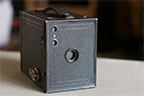
Brownie Camera

The Kodak Brownie was the camera that basically dragged photography out of the “experts only” corner and put it into the hands of everyday folks. Introduced in 1900, it cost one dollar, used roll film, and was dead simple: point, click, wind. That’s it. No settings, no fuss. Kids could use it. Adults who were afraid of cameras could use it. And suddenly millions of people were taking pictures of regular life instead of stiff studio portraits.

It’s not fancy; it’s not sharp by modern standards. But it democratized photography, made snapshots a thing, and set the stage for the entire 20th-century “everyday camera” market.

“You press the button, we do the rest.”

George Eastman changed photography by making it simple and portable. In 1888, he introduced roll film and the Kodak camera — a small box anyone could use. Buyers snapped pictures, then mailed the whole camera back to be developed and reloaded. The slogan said it all: “You press the button, we do the rest.” Eastman took photography out of the studio and put it into everyday hands, launching the age of snapshots.

Mass production of prints and George Eastman

Mass production of prints accelerated thanks to albumen paper and industrial darkroom systems. Images circulated in newspapers, exhibitions, and personal albums, shaping public memory and documenting changing societies. The portrait industry remained strong, but photographers increasingly turned toward street scenes, factories, landscapes, and world travel.

In the 1880s, George Eastman transformed the medium with roll film and the Kodak camera, advertised with the phrase “You press the button, we do the rest.” Photography entered homes, handled by amateurs rather than specialists. Meanwhile, motion studies by Eadweard Muybridge and Étienne-Jules Marey pushed photography toward cinema, capturing movement frame by frame.

By the mid-1880s into the 1890s, photography had become democratized, mobile, and central to culture. What began as a scientific experiment now shaped how people saw the world — and themselves.

Through the 1850s

Through the 1850s, techniques kept improving. Glass negatives replaced paper, giving sharper results. Exposure times dropped from minutes to seconds. Studios opened in major cities and even small towns, turning portraiture into a booming business. The collodion wet plate process arrived mid-decade, fast and detailed, though photographers had to race against drying chemicals in the field.

By the 1860s, photography documented conflict. Images of the American Civil War showed battlefields, soldiers, and death with a blunt truth painting could never match. Cameras traveled on expeditions, mapping frontiers and claiming “new” lands for distant audiences. Albums, trading cards, and stereographs spread photos into homes. In just twenty-five years, photography became a public language — accessible, repeatable, and impossible to ignore.